What Is a Perimeter Alarm System? A Practical Guide
If you’re looking into site security, “perimeter alarm system” is one of the first terms you’ll come across – and one of the most loosely used. Suppliers apply it to everything from a £50 gate sensor to a fully monitored fence-line detection network. That’s a problem if you’re trying to work out what you actually need.
This guide explains what a perimeter alarm system really is, how it differs from the more advanced PIDS category we design and install, and – more usefully – where a basic alarm system is genuinely enough, and where it will leave you exposed.
What a Perimeter Alarm System Actually Does
At its simplest, a perimeter alarm system detects a breach at the edge of a site and raises an alert. That’s the whole job: sense something crossing the line, tell someone about it. It doesn’t identify what caused it, doesn’t usually tell you precisely where along a long boundary it happened, and doesn’t do anything to slow the intruder down. It’s a trigger, not a defence.
That distinction matters more than most buying guides admit. A lot of businesses install a perimeter alarm expecting it to behave like a fuller detection system, then get frustrated when it either floods them with false alarms or misses a breach entirely because the coverage wasn’t designed for their site shape.
The Main Types, and Where Each One Actually Works
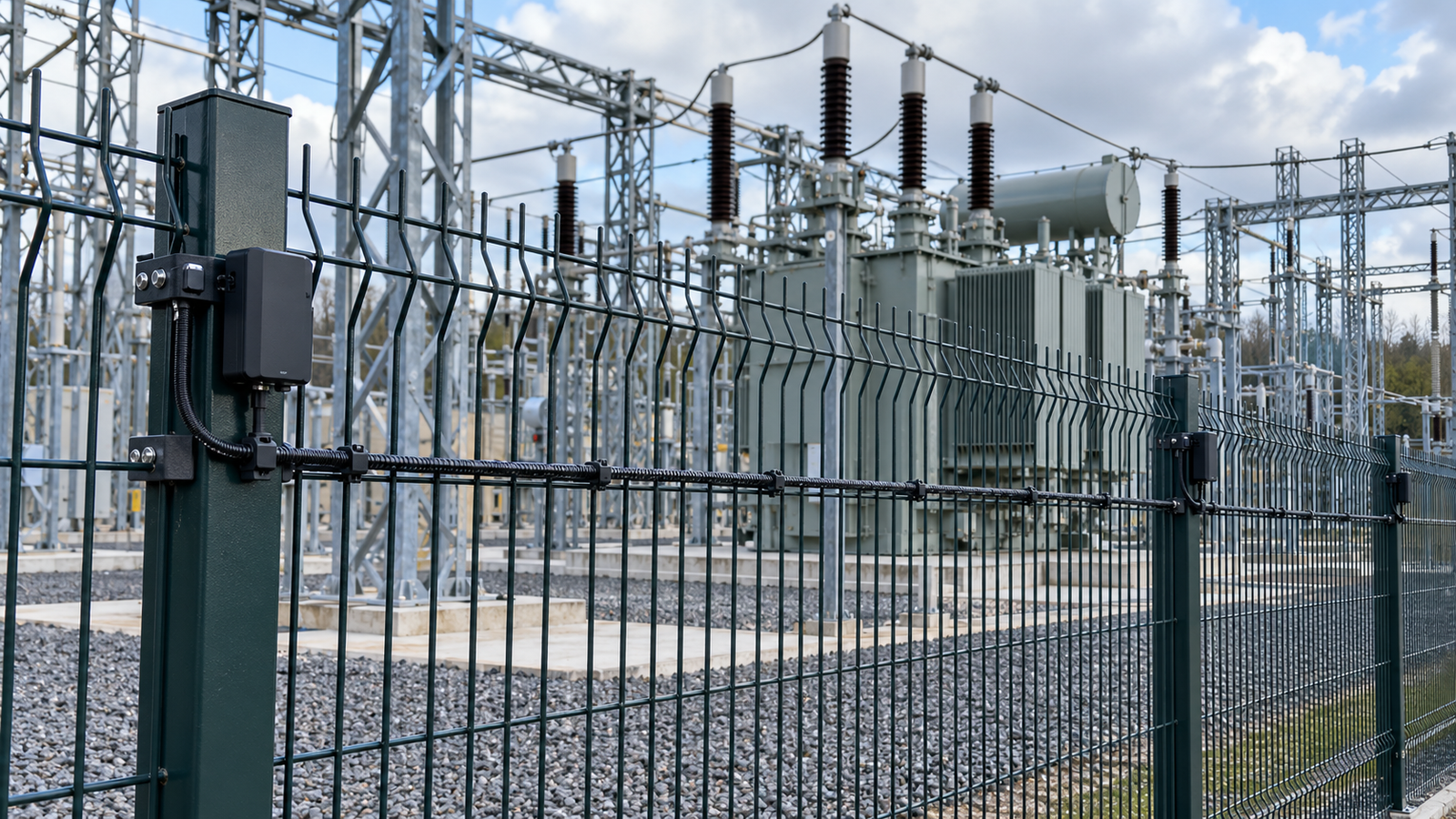
- Fence-mounted sensors (vibration or strain-based) work well on continuous, taut fencing – palisade, mesh, chain-link. They struggle on loose, older, or poorly tensioned fencing, where wind alone can cause enough movement to trigger constant false alarms.
- Break-beam sensors are genuinely reliable for a defined gap – a driveway, a gate, a narrow access point. They’re a poor choice for an irregular or long perimeter; you’d need dozens of beam pairs and still have gaps.
- Buried cable and pressure-based detection suit open boundaries where a fence isn’t wanted or practical – country estates, some agricultural sites. Installation is more disruptive and costly than fence-mounted options, and detection accuracy depends heavily on soil conditions.
- Gate and access point contacts are almost always worth having regardless of what else you install – cheap, reliable, and they cover the most obvious entry point. On their own, though, they only protect the gate, not the rest of the boundary.
- Wireless sensor systems are useful where running cable is impractical, or where the site layout might change. The trade-off is battery maintenance and, on larger or metal-heavy sites, potential signal reliability issues that need proper design to avoid.
None of these is a “best” option in isolation – the right choice depends on your boundary shape, ground conditions, and what’s actually at risk behind it.
Where a Basic Alarm System Stops Being Enough
This is the honest part most supplier content skips. A standard perimeter alarm system tends to break down in three situations:
- Long or irregular perimeters. Past a certain length, a basic alarm tells you a breach happened somewhere on several hundred metres of fence line – not where. Your response team ends up searching, and that delay defeats the point of early warning.
- Sites where false alarms have a real cost. If every gust of wind or fox triggers a callout, alarm fatigue sets in fast – and genuine breaches start getting treated with less urgency. This is one of the most common issues we get called in to fix on sites that installed a basic system without proper design.
- Higher-consequence sites. Anywhere a breach carries serious safety, regulatory, or operational risk – critical infrastructure, utilities, data centres, sites falling under CNI classification – needs detection that locates the threat precisely and resists nuisance triggering. This is the gap PIDS is built to close, and it’s the category we specialise in.
Perimeter Alarm vs PIDS: The Real Difference
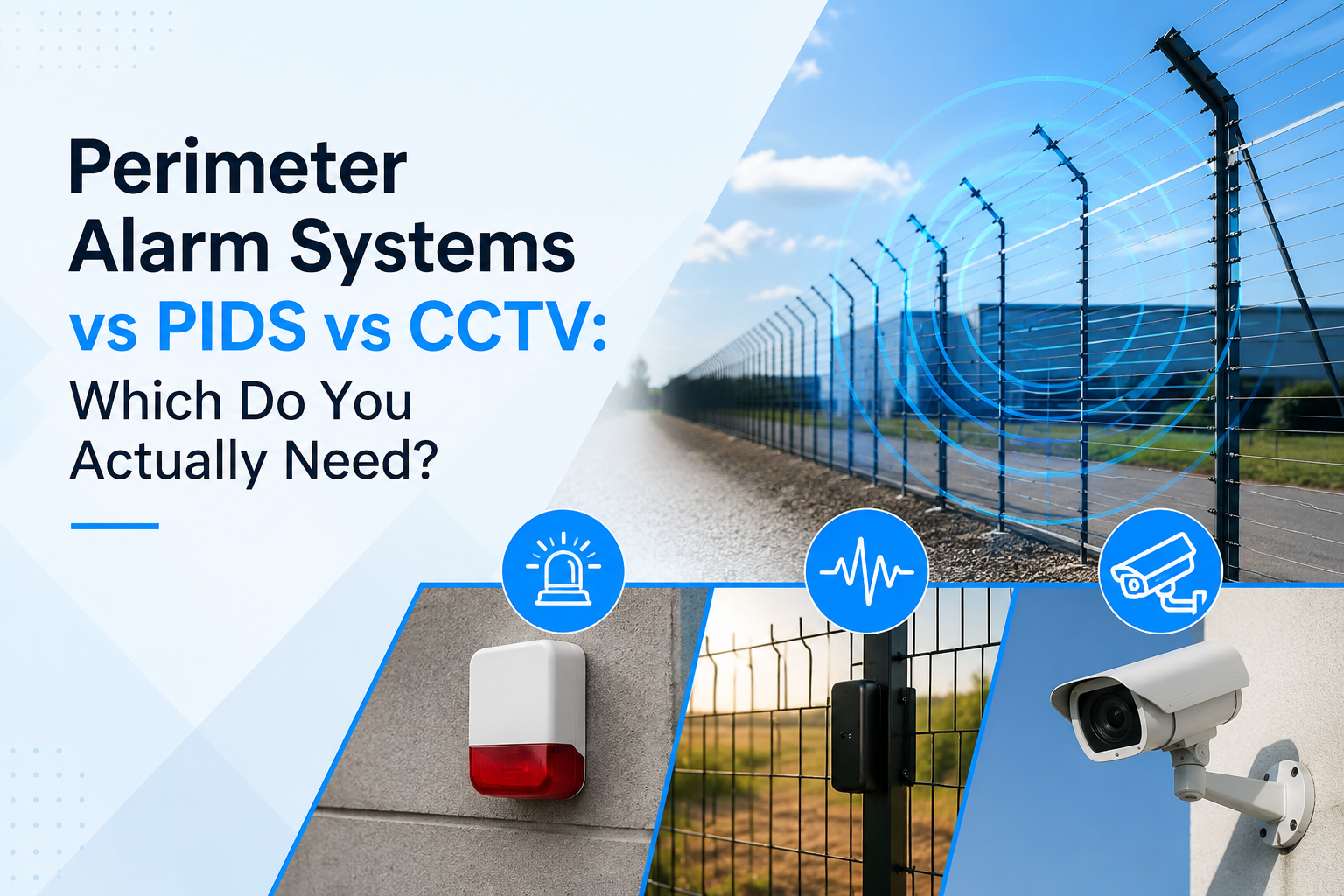
A perimeter alarm system and a PIDS (Perimeter Intrusion Detection System) both sit on the boundary, but they’re not really the same category of product:
- A perimeter alarm system gives you a trigger.
- PIDS is engineered to detect an intrusion attempt, locate it precisely along the fence line, and – in well-designed systems – filter out the environmental noise that causes basic alarms to cry wolf.
This is the level of system we work on daily, using NPSA/CPNI-approved PIDS technology, and it’s built to a different design standard than a retrofit alarm kit – proper site surveys, sensor placement modelling, and integration with monitoring and CCTV response, rather than sensors bolted onto existing fencing as an afterthought.
If you want the fuller breakdown of how PIDS, CCTV, and basic alarm systems fit together, see our guide: Perimeter Alarm Systems vs PIDS vs CCTV: Which Do You Actually Need?
So What Should You Actually Install?
Honestly, it depends on what you’re protecting and what a missed or late detection would cost you:
- Home or small commercial site, lower consequence if missed: A well-specified basic alarm system, ideally paired with CCTV for verification, is often genuinely sufficient. Don’t over-buy here.
- Medium commercial site, valuable stock or equipment: A combination of fence sensors and CCTV usually covers the risk, provided it’s properly designed for your specific boundary rather than a generic kit.
- Critical infrastructure, CNI-classified, or high-consequence sites: This is where a basic alarm genuinely isn’t enough, and where PIDS – properly designed and NPSA/CPNI-compliant – is worth the investment.
The mistake we see most often isn’t choosing the wrong brand of sensor – it’s applying a basic alarm system to a site that actually needed PIDS-level detection, or over-specifying an expensive system on a low-risk site that didn’t need it. Getting this assessment right up front is worth more than any individual product choice.
Frequently Asked Questions
What’s the difference between a perimeter alarm and a standard burglar alarm?
A burglar alarm typically detects intrusion once someone is inside the building. A perimeter alarm system detects a breach at the outer boundary, before the building itself is reached – giving an earlier, though not necessarily precise, warning.
Is a perimeter alarm system enough for a critical infrastructure site?
Generally no. Sites classified as critical national infrastructure typically need detection that precisely locates a breach and resists false triggering – which is what a properly designed PIDS using NPSA/CPNI-approved technology is built for, rather than a standard alarm system.
Why do perimeter alarm systems trigger false alarms?
Most commonly wind, wildlife, loose fencing, or poor initial design – sensors installed without a proper site survey are far more prone to nuisance alarms than a system designed for the specific boundary conditions.
Can a basic perimeter alarm system be upgraded to PIDS later?
In some cases parts of the infrastructure (cabling, monitoring integration) can be reused, but PIDS generally requires a proper design process rather than a straightforward add-on to an existing basic alarm – worth planning for from the outset if there’s a chance your risk profile will increase.
We design and install approved perimeter intrusion detection systems across the UK. If you’re not sure whether a basic alarm system covers your site, or you need something built to a higher standard, talk to our design team – we’ll tell you honestly what your site actually needs, not just what we sell.