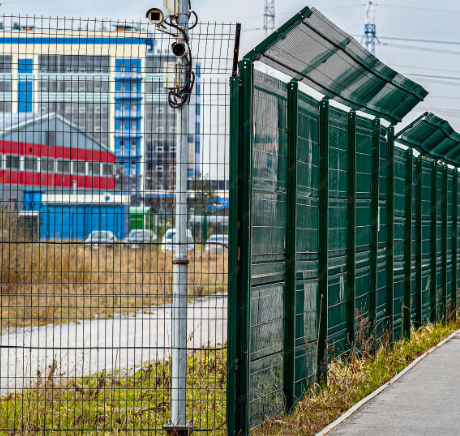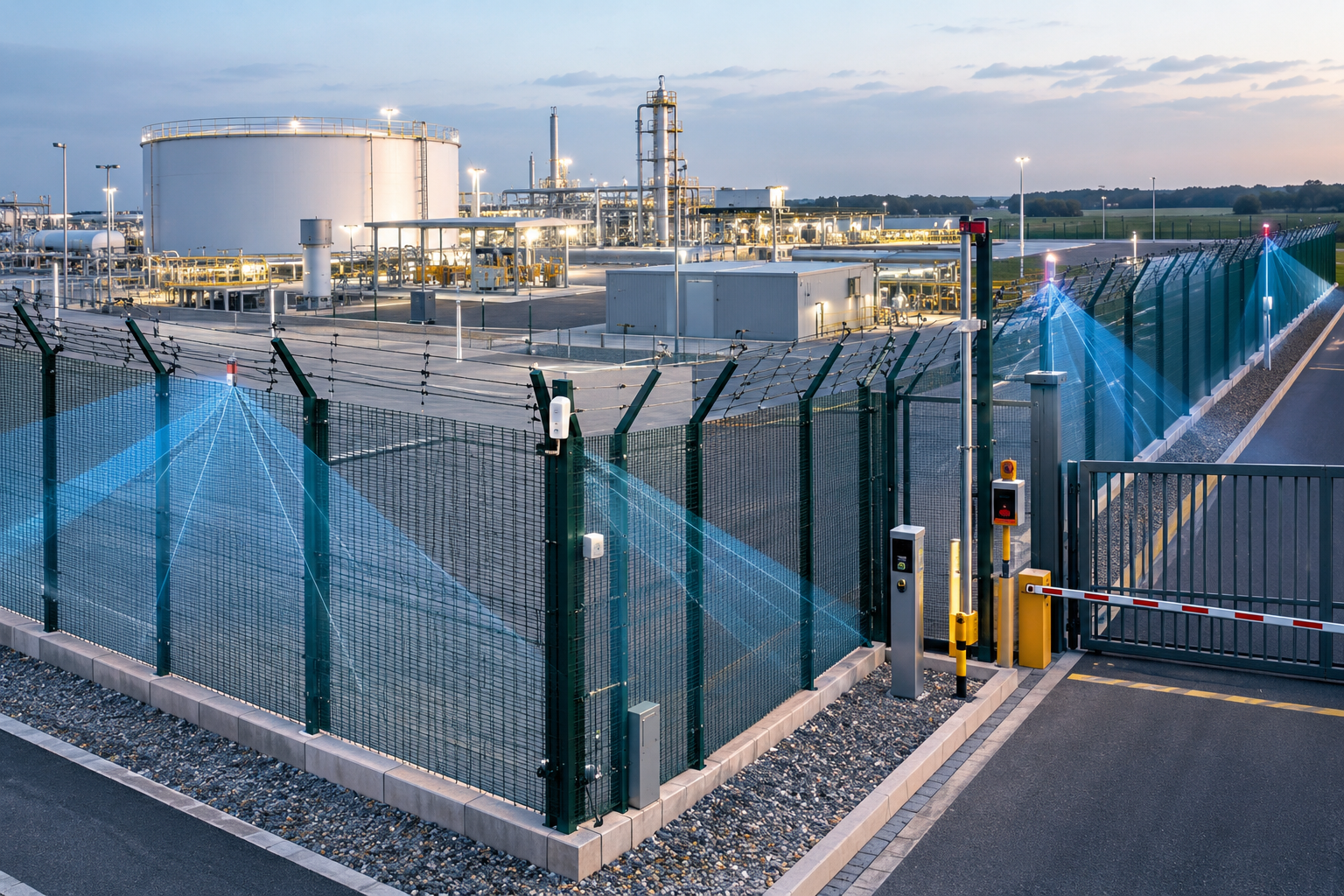
If you manage a high-security site – whether that’s a utility compound, solar farm, industrial facility, government building , prison or construction site – you already know that a fence alone is not enough. Determined intruders can cut, climb or dig under even the most robust barrier.
A perimeter intrusion detection system changes that. It transforms your passive perimeter into an intelligent, active security layer that detects threats in real time – often before a breach has even occurred.
This guide answers every key question about perimeter intrusion detection systems: what they are, how they work, which types are available, what they cost, and how to choose the right supplier and installer.
What Is a Perimeter Intrusion Detection System?
A perimeter intrusion detection system (PIDS) is a sensor-based security solution designed to detect unauthorised access at the outer boundary of a protected site. Rather than waiting for an intruder to reach a building or asset, a PIDS identifies the attempt at the perimeter – at the fence line, wall, gate or open ground – and triggers an immediate alert.
The term PIDS is widely used across the security industry and in official UK government guidance from the National Protective Security Authority (NPSA). It covers a broad family of technologies, all designed with the same purpose: to give security teams the earliest possible warning of an intrusion attempt.
Unlike CCTV, which records what has already happened, a PIDS is proactive. It detects the physical signatures of an intrusion – vibration, tension change, ground movement, acoustic disturbance – and sends an alert within seconds, giving your team time to respond before a breach becomes a crisis.
How a Perimeter Intrusion Detection System Works
Understanding how a perimeter intrusion detection system works helps you specify the right technology for your site and threat profile.
Every PIDS operates through three core stages:
Stage 1 – Detection
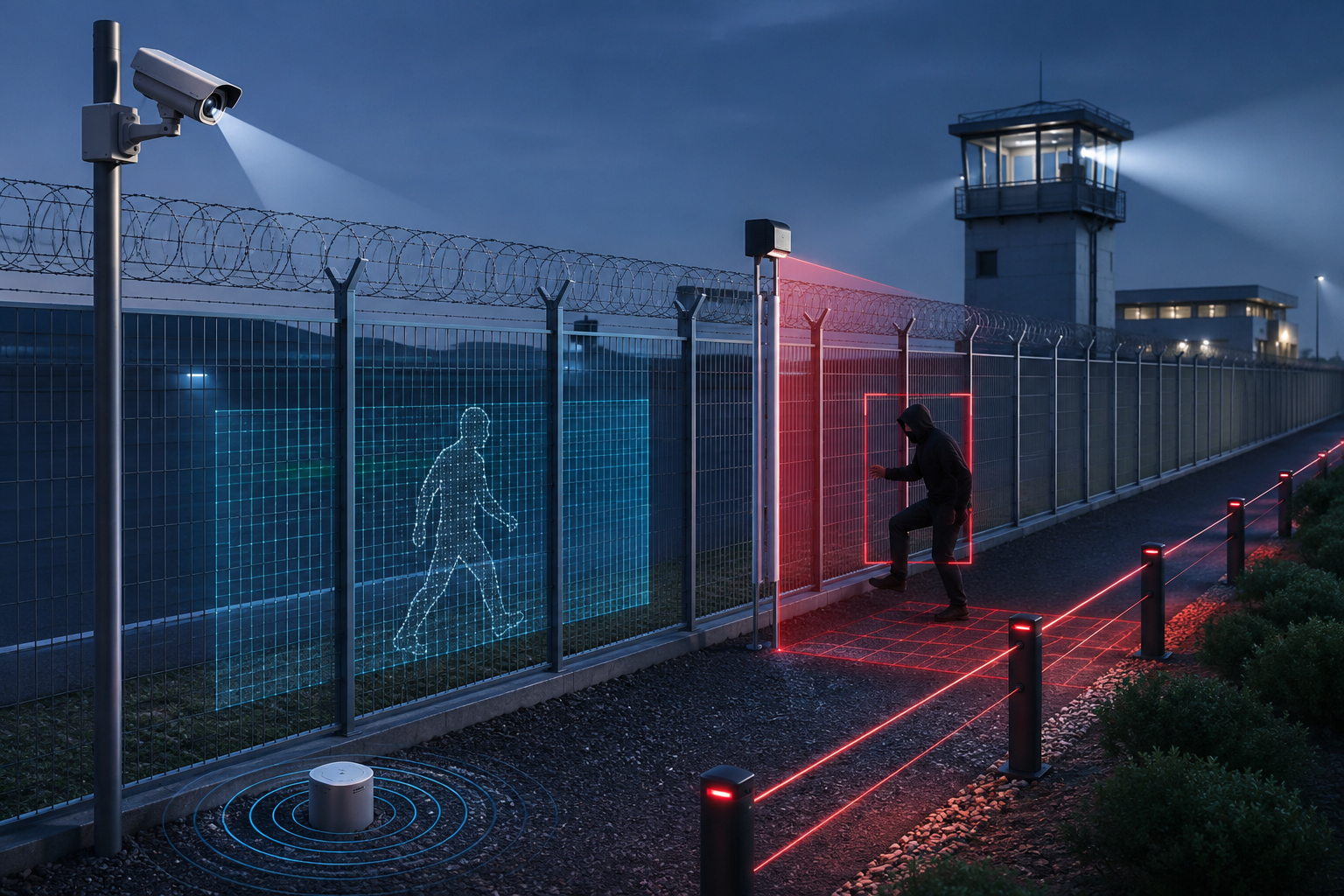
Sensors monitor the perimeter continuously. Depending on the technology, they detect:
- Vibration and mechanical stress on fence panels (fence-mounted systems)
- Pressure and footfall in the ground (buried cable systems)
- Interruption of a beam between transmitter and receiver (microwave/infrared systems)
- Movement across an open area (radar systems)
- Acoustic signatures of cutting or climbing (fibre optic systems)
When any of these signals match a pre-defined threat pattern, the system moves to the next stage.
Stage 2 – Processing and filtering
Raw sensor data passes to a signal processing unit that analyses it against calibrated threat profiles. This is the intelligence layer of the system. It filters out environmental noise – wind, rain, wildlife, passing vehicles – so that only genuine intrusion attempts generate an alarm. This is what separates a high-quality PIDS from systems that produce constant false alarms and erode operator trust over time.
The processing unit also localises the disturbance, identifying the precise point along the perimeter where the activity is occurring – often to within a few metres.
Stage 3 – Alert and response
A confirmed detection triggers an alert that integrates with your broader security infrastructure. In modern installations, this means:
- PTZ or thermal cameras automatically pan to the point of detection
- An alarm is raised in your control room or remote monitoring centre
- Security staff or response teams are dispatched to the correct location
The entire sequence – from detection to camera verification – can happen in under 10 seconds.
Types of Perimeter Intrusion Detection System
There is no single PIDS technology that suits every site. The best system depends on your perimeter type, site size, threat level and operational environment. Here are the main types available:
Fence-Mounted Perimeter Intrusion Detection Systems
The most widely deployed PIDS technology. Sensors – typically vibration-sensitive cables or microphonic sensors – are attached directly to the fence fabric. They detect the physical disturbances caused by climbing, cutting, lifting or damaging the fence.
Fence-mounted systems are suitable for most industrial, commercial and critical infrastructure sites with established perimeter fencing, including palisade, welded mesh and chain-link. They can be retrofitted to existing fences without major structural changes.
Fibre Optic Perimeter Intrusion Detection Systems
Fibre optic cable is woven into the fence or buried in the ground. When disturbed, the cable transmits changes in the light signal passing through it, pinpointing the location of the disturbance with exceptional accuracy. Fibre optic PIDS is particularly well suited to high-security sites where precise localisation and resistance to electromagnetic interference are priorities.
Buried Cable and Ground Sensor Systems
Sensors or cables are buried beneath the ground around the perimeter, creating an invisible detection zone. These systems detect footfall, digging, or vehicle movement without any visible surface hardware – making them ideal for sites where covert detection is required, or where a sterile zone inside the fence line needs to be monitored.
Microwave and Infrared Beam Systems
A transmitter and receiver create an invisible detection beam across a defined zone. Any object that breaks the beam triggers an alarm. These systems are widely used at entrance points, gaps in fencing, or as a secondary detection layer behind the main perimeter fence.
Radar-Based Detection Systems
Radar sensors continuously scan a wide area – in some cases several kilometres – detecting movement and automatically directing PTZ or thermal cameras to the target. Radar is particularly well suited to large open sites such as solar farms, airports and ports, where the sheer scale of the perimeter makes fence-mounted detection impractical or cost-prohibitive.
Perimeter Intrusion Detection and Assessment Systems (PIDAS)
A PIDAS combines detection with an integrated assessment layer – typically CCTV, thermal imaging or radar – that allows security operators to immediately verify and assess an alarm without leaving the control room. A PIDAS is the gold standard for high-security environments where the cost of a missed intrusion is unacceptably high. Many CNI sites, government facilities and prisons are required to operate to PIDAS standards.
Which Sites Need a Perimeter Intrusion Detection System?
Perimeter intrusion detection is no longer exclusive to military or government sites. A wide range of sectors now deploy PIDS as standard operational security:
Critical National Infrastructure (CNI) Power stations, water treatment facilities, gas networks and telecoms infrastructure operate under NPSA security guidance that mandates perimeter detection. The consequences of a breach at these sites – operational disruption, public safety risk – make PIDS non-negotiable.
Solar and Renewable Energy Farms Solar farms span hundreds of acres of open, often rural land with minimal on-site staffing. They are high-value targets for theft of copper cabling, panels and inverters. Radar-based and fence-mounted PIDS systems provide 24/7 protection without the cost of permanent guards.
Industrial and Manufacturing Sites High-value plant, raw materials, proprietary equipment and IP make industrial sites attractive targets. PIDS provides an outer layer of defence that CCTV and guards alone cannot match.
Logistics and Distribution Centres Large sites with constant vehicle and pedestrian movement need systems that detect genuine threats without generating constant false alarms. Modern PIDS calibrated for logistics environments manages this reliably.
HM Prisons and Government Sites Correctional facilities and government establishments are required to maintain certified perimeter detection systems. Sysco Tech has direct experience delivering PIDS solutions for some of the UK’s most secure government sites.
Construction Sites Theft from construction sites costs the UK industry hundreds of millions of pounds annually. Temporary PIDS installations protect plant, copper, tools and materials during the build programme – and can be relocated when the project completes.
Airports and Transport Hubs Complex multi-zone perimeters with strict regulatory requirements demand layered PIDS solutions integrating radar, thermal imaging and fence-mounted sensors with airside security management systems.
How to Compare Perimeter Intrusion Detection System Features and Prices
When comparing perimeter intrusion detection systems, price alone is a poor guide to value. The features that matter most are:
- Detection accuracy and nuisance alarm rate Ask any supplier for documented nuisance alarm rate data – how frequently the system generates false alarms per kilometre of fence per month. High nuisance alarm rates lead to alarm fatigue, where operators stop responding promptly because they expect most alerts to be false.
- Localisation precision How accurately does the system identify where on the perimeter the disturbance is occurring? For a 500-metre fence line, pinpointing activity to within 5 metres is far more useful than a zone-level alert.
- Integration capability Does the system integrate with your existing CCTV platform, alarm system, access control and control room software? A PIDS that operates in isolation provides limited operational value.
- Scalability Can the system be extended as your site grows, or reconfigured if your perimeter layout changes? Avoid proprietary systems that lock you into a single supplier for any future expansion.
- Weather and environmental performance Request IP ratings and operating temperature ranges. UK conditions are demanding – persistent rain, frost, strong winds and fog are normal, and your PIDS must perform through all of them.
- Installer accreditation and track record Installation quality directly determines system performance. Verify that the installer holds relevant accreditations (NICEIC, Constructionline, CHAS, SafeContractor) and has demonstrable experience on comparable sites.
- Aftercare and maintenance Confirm that 24/7 maintenance and emergency response is included. A security-critical system with no maintenance contract is a liability, not an asset.
How Much Does a Perimeter Intrusion Detection System Cost?
The cost of a perimeter intrusion detection system varies considerably depending on:
- The length of the perimeter to be protected
- The detection technology selected
- The complexity of integration with existing systems
- The level of aftercare and monitoring required
A fence-mounted detection system for a small to medium industrial site will cost significantly less than a multi-technology radar and thermal solution for a large CNI facility.
Rather than publishing indicative figures that may not reflect your site’s specific requirements, Sysco Tech provides free site assessments and detailed quotations tailored to your perimeter, threat profile and budget. This is always the right starting point – a system that is under-specified for your site is not a saving.
Contact our team on 01772 621716 or email enquiries@syscotech.co.uk for a free consultation.
The Best Perimeter Intrusion Detection Systems for Large Industrial Sites
For large industrial sites, the key requirements are:
- Long-range detection across extensive fence lines
- Low nuisance alarm rates in high-traffic environments
- Seamless integration with site-wide security management
- Robust performance in outdoor conditions year-round
At Sysco Tech, we work with leading manufacturers to design and install systems that meet these demands. Our solutions are fully bespoke: no two sites are the same, and no two systems should be either.
The Latest Technologies in Perimeter Intrusion Detection
The PIDS sector has advanced significantly in recent years. Key developments include:
- AI-driven signal processing Machine learning algorithms are now embedded in processing units, continuously improving their ability to distinguish genuine threats from environmental noise. Systems learn from the specific conditions of your site over time, reducing nuisance alarms without compromising detection sensitivity.
- Radar fusion systems Combining radar detection with thermal imaging and PTZ cameras creates a fully automated detection-to-verification workflow. When the radar detects movement, thermal cameras identify the heat signature and PTZ cameras lock on – all without human intervention. Response times drop dramatically.
- Wireless fence detection Traditional fence-mounted systems require cable runs back to processing units. Modern wireless detection nodes communicate via encrypted radio, reducing installation complexity and cost – particularly on large or complex sites.
- Integration with remote monitoring centres Cloud-connected PIDS platforms now allow alarms, camera feeds and system health data to be monitored by remote security operations centres 24/7 – removing the dependency on on-site staffing for effective response.
Why Choose Sysco Tech as Your PIDS Installer?
Sysco Technical Solutions has over 20 years of experience designing, installing and maintaining perimeter intrusion detection systems for the most demanding sites in the UK – including nuclear facilities, national utility locations, HM Prisons, solar farms and major industrial complexes.
Our credentials:
- Security-cleared engineers
- NICEIC registered
- Constructionline approved
- CHAS accredited
- SafeContractor certified
We supply, install and maintain the full range of PIDS technologies – from fence-mounted detection and fibre optic systems to radar fusion and PIDAS solutions – and integrate them with CCTV, access control and remote monitoring platforms.
Every project starts with a thorough site survey. We assess your perimeter, identify vulnerabilities, and design a system that is precisely matched to your threat profile, environment and budget.
Call 01772 621716 or email enquiries@syscotech.co.uk to book your free site assessment today.
Frequently Asked Questions
What is a perimeter intrusion detection system?
A perimeter intrusion detection system (PIDS) is a sensor-based security technology that detects unauthorised access attempts at the outer boundary of a site in real time. It monitors the fence, wall, or open ground for physical signatures of intrusion – climbing, cutting, digging or movement – and triggers an immediate alert, enabling security teams to respond before a breach occurs.
How does a perimeter intrusion detection system work?
A PIDS works in three stages. First, sensors continuously monitor the perimeter for physical disturbances. Second, a processing unit analyses the sensor data, filters out environmental noise (wind, rain, wildlife), and identifies the location of any genuine threat. Third, a confirmed detection triggers an integrated alert – directing cameras to the point of intrusion and notifying your control room or monitoring centre automatically.
What is the difference between PIDS and PIDAS?
PIDS (Perimeter Intrusion Detection System) detects intrusion at the boundary. PIDAS (Perimeter Intrusion Detection and Assessment System) adds an integrated assessment layer – typically CCTV or thermal imaging – that allows operators to immediately verify the nature of the alert without leaving the control room. PIDAS is the standard required for many high-security and government sites.
What are the main types of perimeter intrusion detection system?
The main types are fence-mounted detection systems, fibre optic detection systems, buried ground sensors, microwave and infrared beam systems, and radar-based detection. The right choice depends on your perimeter type, site size, environment and required detection range. Most high-security sites use a combination of technologies.
Which companies supply perimeter intrusion detection systems?
Key suppliers and integrators in the UK include Sysco Technical Solutions, Gallagher, Geoquip (a division of Heras), and Senstar. Sysco Tech provides end-to-end supply, installation and maintenance services across the UK.
How much does a professional perimeter security system installation cost?
Costs vary significantly based on perimeter length, technology type and integration complexity. A fence-mounted system for a medium-sized industrial site will cost considerably less than a multi-technology solution for a CNI facility. Sysco Tech provides free site assessments and detailed tailored quotations – contact our team to get accurate pricing for your specific requirements.
Can a perimeter intrusion detection system be installed on an existing fence?
Yes. Most fence-mounted and fibre optic PIDS technologies can be retrofitted to existing fence structures, including palisade, welded mesh and chain-link fencing. Sysco Tech’s engineers assess your existing infrastructure during the site survey and recommend the most suitable solution.
Where can I find perimeter intrusion detection system installation services near me?
Sysco Technical Solutions provides perimeter intrusion detection system installation services across the UK. Our security-cleared, fully accredited engineers are deployed nationally. Contact us on 01772 621716 or at enquiries@syscotech.co.uk and we will arrange a site visit at your location.
How do I compare perimeter intrusion detection system features and prices?
Focus on nuisance alarm rate, localisation accuracy, integration capability, environmental performance and installer accreditation – not price alone. A system that generates constant false alarms or fails in wet weather provides no security value regardless of its purchase cost. Sysco Tech is happy to walk you through a comparative assessment of the technologies most suitable for your site.
What are the latest technologies used in perimeter intrusion detection systems?
The most significant recent developments are AI-driven signal processing (which reduces nuisance alarms by learning site-specific conditions), radar fusion systems (combining radar, thermal and PTZ for fully automated detection and verification), wireless fence detection nodes, and cloud-connected remote monitoring integration. Sysco Tech deploys all of these technologies and can advise on which are most relevant to your site.
Ready to Secure Your Perimeter?
Whether you are specifying a perimeter intrusion detection system for the first time or reviewing an existing installation, Sysco Technical Solutions has the expertise to help.
Our team will carry out a thorough site assessment, identify your specific vulnerabilities, and design a PIDS solution built precisely for your environment – with full installation, commissioning and 24/7 aftercare support.
Call us on 01772 621716 Email: enquiries@syscotech.co.uk Based in Lancashire – serving sites across the UK
Sysco Technical Solutions | Specialists in Perimeter Intrusion Detection Systems | NICEIC Registered | CHAS Accredited | Constructionline Approved | SafeContractor Certified