Every layer of a data centre’s security stack – access control, biometric doors, mantraps, CCTV, SOC monitoring – exists behind one thing: the fence line. It’s the first physical boundary an intruder meets, and if it isn’t designed and detected properly, everything behind it is working harder than it needs to.
This guide is for facilities and security managers who already know they need a secure perimeter and want the specifics: what fence type to specify, which detection method suits a data centre environment, how to structure the layout, and how to stop false alarms from becoming an operational problem.
Why the Fence Line Matters More at a Data Centre Than Almost Anywhere Else
Most sites can tolerate an occasional false alarm or a slow detection response. A data centre generally can’t. An unnecessary lockdown or an unverified alert that triggers a response protocol has knock-on effects on uptime commitments, client SLAs, and – for colocation and hyperscale operators – contractual penalties. That changes the calculus for fence design in three ways:
- Detection has to be accurate, not just present. A system that “mostly” works isn’t good enough when every false positive costs staff time and every missed event risks a breach of a Tier-rated facility.
- The fence has to integrate, not sit on its own. Detection data needs to talk to the SOC, the BMS, and the CCTV estate as one coordinated picture, not four separate systems generating four separate alerts.
- The site rarely gets a second chance to get it right. Data centres are commissioned once and run for years. Retrofitting a fence line after a live incident is far more disruptive than specifying it correctly from day one.
The 5 Ds of Data Centre Perimeter Security
High-security fence design is generally built around five functions, and it’s worth using this as a checklist for any data centre perimeter:
- Deter – does the fence line visibly discourage an attempt before it starts? Height (typically 2.4m–3m or more), rigidity, anti-climb toppings and lighting all play a role here.
- Detect – does the system identify an intrusion attempt early enough to act, ideally before the fence itself is breached?
- Deny – does the fence and access point layout physically prevent entry rather than just slowing it down – controlled gates, turnstiles and mantraps funnelling all traffic through defined points?
- Delay – if someone does attempt a breach, how long does the fence physically hold them up, and does that delay match your response time? This is where forced-entry certification matters (see below).
- Defend – does your response protocol give staff and systems enough time and information to intervene before the delay period runs out?
A fence that only deters but doesn’t detect is a false sense of security. A detection system with no physical delay behind it gives your response team no time to act. Data centres need all five working together, not just the parts that are easiest to install.
Fencing Standards and Certification
Beyond fence type, UK data centre operators increasingly need to show that the fencing itself has been independently tested, not just installed to a reasonable-looking spec:
- Forced entry certification (LPS 1175 / NPSA-aligned ratings) – independently tested standards that confirm how long a fence withstands sustained attack with hand or power tools. This is the figure that should inform your “Delay” calculation above, and is what insurers and auditors increasingly ask to see evidence of.
- Anti-climb, anti-cut mesh (often referred to as 358 or “prison” mesh) – welded wire mesh with apertures small enough to prevent finger-holds or bolt cutter access, widely used as the primary structural layer on new-build data centre sites.
- Height and toppers – most data centre perimeters run 2.4m to 3m or higher, often finished with barbed wire, razor wire or curved pale toppers to increase both deterrence and climb time.
Asking a prospective installer which certification standard their fencing is tested to – and asking to see the certificate – is one of the simplest ways to separate a genuinely high-security specification from one that just looks the part.
Fence Types Used on Data Centre Sites
Most UK data centre perimeters use one of two structural fence types, sometimes in combination:
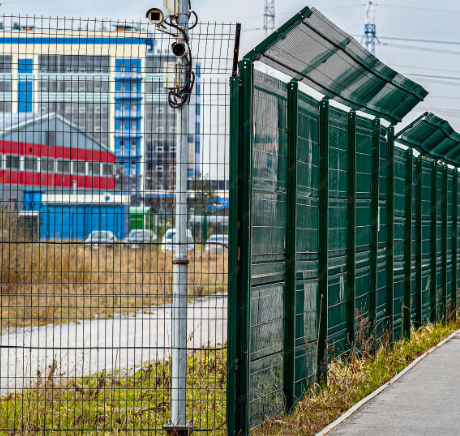
- Weld mesh fencing – rigid, hard to climb, and difficult to cut quickly. Common as the primary structural barrier on new-build sites.
- Palisade fencing – a traditional high-security option, often used where a stronger visual deterrent and higher delay rating is required.
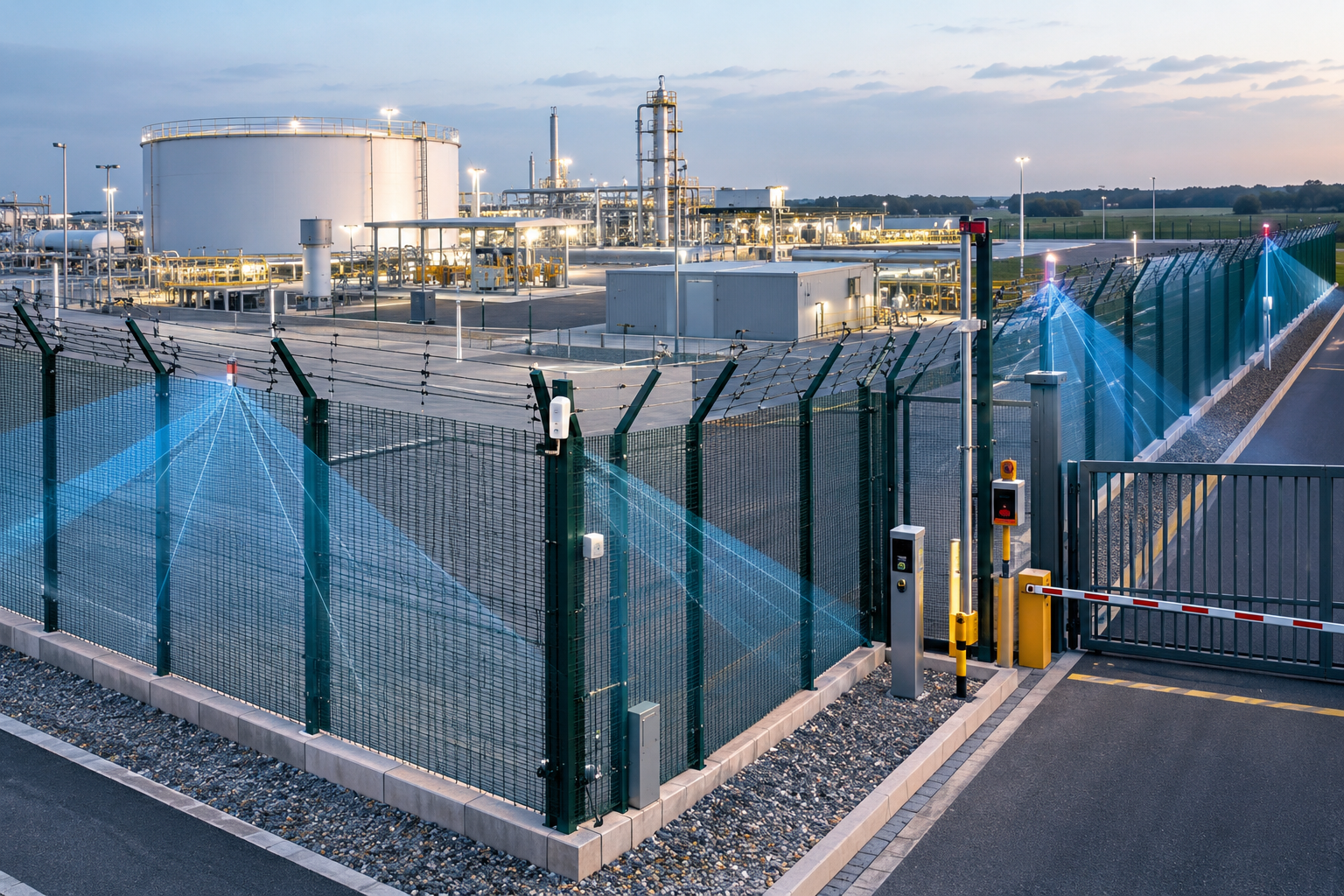
For higher-security or hyperscale sites, a dual fence line with a sterile zone is increasingly standard: two fence lines separated by a clear gap of several metres, with the outer line carrying its own detection and the sterile zone monitored independently, often by radar, infrared beams or buried sensors. This layered approach means an intruder has to defeat detection twice, which significantly reduces the chance of an undetected breach and gives your response team a longer window to act.
Detection Methods: Which Suits a Data Centre?
There’s no single “best” sensor for every data centre – the right choice depends on the fence type, site layout, and how sensitive you need detection to be. The main options:
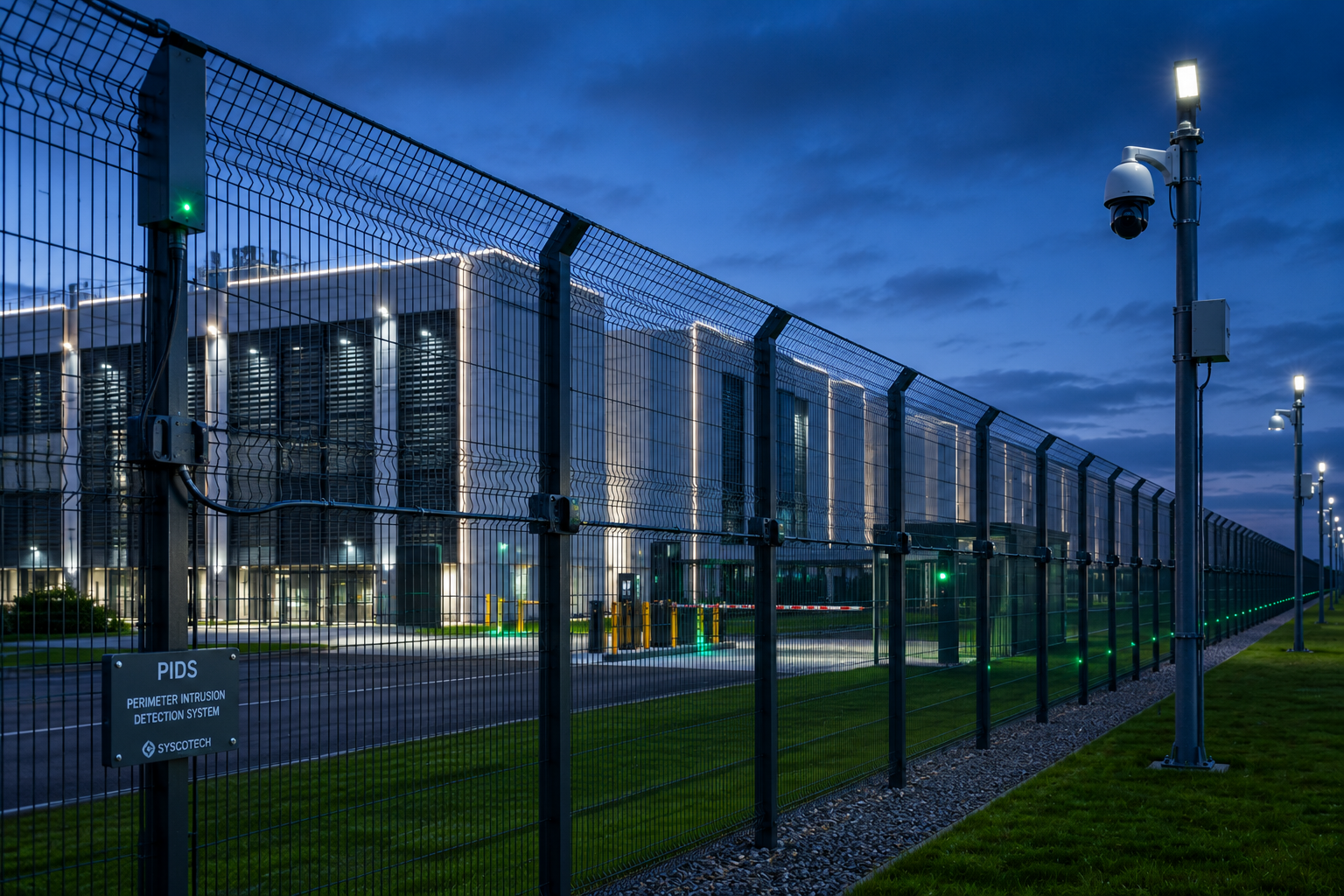
- Fibre optic fence-mounted sensors – detect vibration from climbing or cutting along the entire fence length, with the ability to pinpoint the location of an event. Low maintenance and well suited to long perimeters, which makes them a common choice for larger data centre campuses.
- Microphonic / vibration cable sensors – similar principle, tuned to distinguish an intrusion attempt from background noise like wind or wildlife. Effective on mesh and palisade fencing alike.
- Taut wire systems – a mechanical option where wires under tension trigger an alert if cut or displaced. Very low false alarm rates, though typically better suited to shorter, high-value perimeters than sprawling campuses.
- Buried cable and radar (for sterile zones) – used less on the fence itself and more in the gap between dual fence lines, providing volumetric detection independent of the fence structure.
- Electric pulse fencing – a hybrid deterrent-and-detection option that runs a high-voltage, low-amperage pulse along the fence line, acting as a visible deterrent while also triggering an alarm if cut, climbed or tampered with. More commonly seen on very high-security or remote sites where a stronger physical deterrent is wanted alongside detection.
For most data centres, a fence-mounted fibre optic or microphonic system on the primary fence line, combined with radar or infrared in a sterile zone where one exists, gives the best balance of coverage, low maintenance and detection accuracy.
Hostile Vehicle Mitigation (HVM)
Fencing alone doesn’t address vehicle-borne threats, and data centres – particularly those near public roads or with limited standoff distance – increasingly need to factor this in alongside standard perimeter detection:
- Crash-rated fencing and barriers, tested against standards such as PAS 68 or ASTM F2656, are designed to withstand vehicle impact at a specified speed and weight rather than simply act as a visual boundary.
- Bollards and roadblockers are typically placed at access points and along stretches of fence line closest to roads, protecting against both accidental incursions and deliberate ramming attempts.
Not every site needs this level of protection – it depends on proximity to public roads, the value and criticality of the facility, and the outcome of a proper vehicle dynamics assessment – but it’s worth raising with your installer at the design stage rather than retrofitting later.
The Construction-Phase Gap
Data centres are often at their most vulnerable before they’re even operational. During the build phase, valuable cabling, switchgear and equipment sit on-site, frequently behind nothing more than standard construction hoarding – a gap that’s easy to overlook when planning focuses on the finished, operational site.
The better approach is to specify temporary, modular fencing rated to the same forced-entry standards (such as LPS 1175) as the permanent perimeter, which can either be upgraded in place or transitioned directly into the permanent fence line once construction completes. This closes the security gap during the highest-risk phase of the project instead of treating detection as something that only starts once the site goes live.
Managing False Alarms – The Metric That Matters Most at a Data Centre
Nowhere is false alarm management more business-critical than on a data centre site. A handful of practical measures make the biggest difference:
- Sensor calibration to the specific fence and site conditions – a system tuned for a different fence type or a windier site than it’s actually installed on will over-trigger.
- Alarm verification through CCTV integration – pairing detection with automatic camera call-up so an operator can visually confirm an event within seconds, rather than dispatching a response to every alert.
- Zoned reporting – dividing the perimeter into discrete sections so the SOC knows exactly where an event occurred, rather than treating the whole fence line as one alarm zone.
- Ongoing maintenance and recalibration – fence tension changes with weather and age, and detection systems need periodic review to keep performing as specified, not just at commissioning.
Integration with SOC, BMS and Access Control
A fence detection system that operates in isolation is only doing half its job. On a well-designed data centre site, a fence-line alert should automatically:
- Call up the relevant CCTV camera for visual verification
- Log the event with a timestamp and precise location on the perimeter
- Feed into the same monitoring platform the SOC already uses for access control and building systems, rather than requiring staff to watch a separate screen
This single-pane-of-glass approach is what turns a fence sensor into a genuine part of the security operation, rather than another alarm competing for attention.
Compliance and Planning Considerations
UK data centres – particularly those supporting critical national infrastructure, financial services or government contracts – increasingly need to demonstrate that their physical security has been designed to a recognised standard, not assembled ad hoc. NPSA (formerly CPNI) guidance is the reference point most UK security consultants and insurers expect to see referenced in a data centre’s security design documentation. Working with an NPSA-aligned installer from the outset avoids costly redesign later if a client audit or insurance review asks for evidence of a structured, standards-based approach.
Planning and aesthetics also matter more for data centres than for many industrial sites, particularly on business parks where a stark high-security fence line may face objections. Detection technology that integrates discreetly with a lower-profile fence can often meet security requirements without the site looking like a military installation.
Frequently Asked Questions
What is the best fence for a data centre?
There’s no universal answer – it depends on the site’s risk profile and layout. Weld mesh is the most common primary fence type for new-build data centres due to its rigidity and climb resistance, with palisade fencing used where a stronger visual deterrent is needed. Higher-security sites often pair the fence with a second inner line and a sterile zone in between.
Do data centres need a PIDS, or is CCTV enough?
CCTV alone typically can’t provide continuous, reliable early warning across a long perimeter – it depends on someone actively watching or reviewing footage after the fact. A Perimeter Intrusion Detection System (PIDS) gives real-time alerts the moment a fence is approached, climbed or cut, with CCTV then used to verify the event. The two work best together, not as alternatives.
What is a sterile zone in data centre perimeter security?
A sterile zone is the gap – typically several metres – between two parallel fence lines. It’s monitored independently of the fences themselves, often with radar, infrared beams or buried sensors, so an intruder who somehow bypasses the outer fence still has to cross a second, separately detected zone before reaching the building.
How do you stop false alarms on a data centre fence line?
Through a combination of correctly calibrated sensors matched to the fence type and site conditions, automatic CCTV verification of every alert, zoned reporting so the SOC knows precisely where an event occurred, and regular recalibration as fence tension and weather conditions change over time.
What standards apply to data centre fence security in the UK? There’s no single mandatory fencing standard for all UK data centres, but NPSA (National Protective Security Authority, formerly CPNI) guidance is the widely recognised reference point for perimeter security design, and is increasingly expected by insurers and clients on critical or high-security sites. Uptime Institute Tier standards also factor into overall resilience requirements, including physical security.
Can data centre fence detection integrate with existing security systems?
Yes – and it should. A fence-line detection system that doesn’t feed into the same platform as your CCTV, access control and building management system creates blind spots and slows response times. Most modern PIDS platforms are designed to integrate with existing SOC and BMS infrastructure rather than operate as a standalone system.
How much does data centre fence security cost?
Costs vary significantly based on perimeter length, chosen detection technology, whether a dual fence line and sterile zone are required, and integration complexity with existing systems. A site-specific survey is the only reliable way to get an accurate figure – get in touch for a free assessment.
Are data centres heavily guarded?
Modern data centres typically rely on a layered combination of physical fencing, electronic detection, CCTV and access control rather than large manned guard forces alone. The perimeter fence and its detection system are designed to do much of the continuous monitoring work, with security personnel responding to verified alerts rather than patrolling the entire boundary constantly.
What is the biggest security issue with data centres?
Beyond cyber threats, the most common physical security gaps are inconsistent perimeter coverage (blind spots where fencing, lighting or detection don’t fully overlap), poor integration between fencing, CCTV and access control systems, and inadequate protection during the construction phase before the site is fully operational.
What is a safe distance from a data centre for security purposes?
This depends on the site’s specific vehicle dynamics assessment and threat level rather than a fixed industry figure – it factors into whether hostile vehicle mitigation measures like crash-rated barriers or bollards are needed, and how far back from the fence line they should sit.
Get Your Fence Line Assessed
Sysco Technical Solutions designs, installs and maintains NPSA-aligned perimeter intrusion detection systems for UK data centres, from single-fence sites to multi-layered campuses with sterile zones. Book a free site survey and we’ll assess your perimeter and recommend the right fence security solution for your facility.
Call 01772 621716 or email enquiries@syscotech.co.uk
Click Learn more about perimeter intrusion detection systems