Introduction
How high should a perimeter security fence be? There is no single height that is suitable for every site.
The correct security fence height depends on the site’s risk profile, what is being protected, the consequences of an intrusion, the surrounding environment, the likelihood of climbing or forced entry, the fence design, gates and other access points, and whether the perimeter is supported by perimeter intrusion detection or other security measures.
For UK high-risk environments, current NPSA guidance provides useful benchmarks, but these should not be treated as a universal legal requirement. NPSA recommends security fence panels of at least 2.4m for its defined security-fence application, with a minimum 3.0m panel height for higher security requirements. The appropriate specification still needs to be determined by the site’s operational requirement and risk assessment.
The key point is simple:
A taller fence is not automatically a more secure fence.
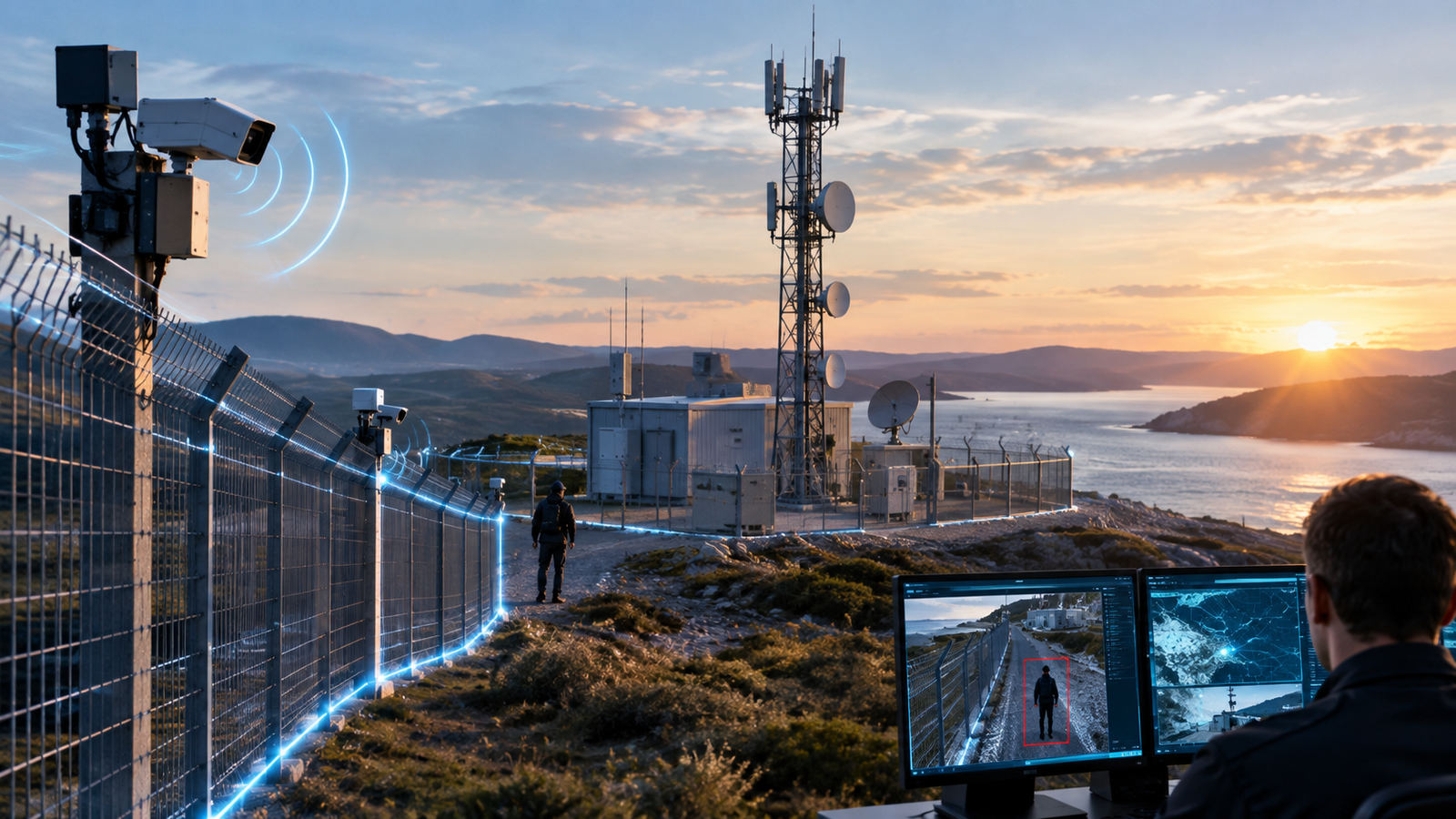
Effective perimeter protection depends on the complete system – combining an appropriate physical barrier with detection, secure access points and an effective response.
Quick Answer
Perimeter security fence height depends on the risk and security requirements of the site. While taller fencing can increase deterrence and delay, height alone does not determine how secure a perimeter is. Fence design, anti-climb characteristics, gates, perimeter intrusion detection and response arrangements all need to be considered together.
What Is the Standard Height for a Perimeter Security Fence?
There is no universal UK height that applies to every security fence.
Commercial premises, industrial sites and critical infrastructure can have very different security requirements. A perimeter fence around a lower-risk commercial property may have a completely different specification from one protecting a critical utility, data centre, energy facility or other high-risk asset.
For organisations looking for an authoritative starting point, NPSA guidance is particularly relevant. NPSA recommends panels with a minimum height of 2.4m for its security-fence application. For higher security requirements, it recommends panels of at least 3.0m, together with additional anti-climb measures.
These figures should be understood as security design guidance rather than blanket legal requirements.
The relevant specification should also consider fence construction, gates, anti-climb measures and the integration of appropriate perimeter intrusion detection systems.
This means that while 1.8m, 2m, 2.4m and 3m fences may all be encountered in different applications, the question should not simply be:
“Which fence height should we choose?”
The more important question is:
“What level of physical protection and delay does this site require?”
Is a 2-Metre Security Fence High Enough?
A 2-metre security fence may be appropriate for some applications, but it should not automatically be considered sufficient for a high-risk site.
Height is only one part of the security equation.
A 2m fence with robust construction, appropriate anti-climb characteristics, secure gates and effective perimeter intrusion detection may provide better overall protection than a taller fence with weak access points or no means of detecting an intrusion attempt.
The assessment should consider:
- The site’s threat profile
- The likelihood of someone attempting to climb the fence
- The fence construction and resistance characteristics
- Potential footholds or handholds
- Objects or structures close to the perimeter
- Ground conditions and changes in terrain
- The required delay before a security response
- The value and criticality of the protected assets
- Whether perimeter intrusion detection is required
- How alarms will be assessed and responded to
For higher-security applications, NPSA’s guidance provides a useful distinction between its standard security-fence application and higher security requirements.
Therefore, asking whether “2m is enough” without understanding the site’s threat and security objectives can produce a misleading answer.
Does a Taller Perimeter Fence Mean Better Security?
A taller fence can provide greater physical separation, make climbing more difficult and potentially provide additional delay. It can also act as a stronger visual deterrent.
But height alone does not create a secure perimeter.
A 3m fence can still have vulnerabilities at gates, vehicle entrances, pedestrian access points, ground-level gaps or locations where nearby structures compromise the boundary.
This is why effective perimeter security fencing should be considered as part of a wider perimeter protection strategy.
The objective should be to create a perimeter that is:
Difficult to penetrate → capable of detecting an intrusion attempt → capable of supporting an appropriate response.
That is a much more useful security objective than simply specifying the tallest possible fence.
What Makes a Perimeter Security Fence Difficult to Climb?
Effective security fencing is designed around more than its overall height.
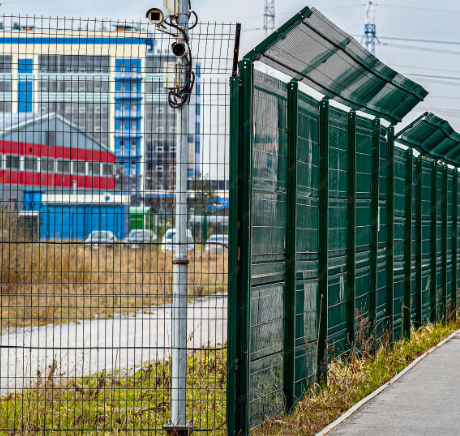
An anti-climb security fence should be considered in terms of its overall construction, profile and surrounding environment.
Important design considerations include:
- Fence type and configuration
- Mesh or panel characteristics
- Structural rigidity
- Potential footholds or handholds
- Gaps between components
- The gap between the fence and ground
- Appropriate anti-climb topping
- Objects positioned close to the perimeter
- Compatibility with perimeter intrusion detection technology
The objective is to make unauthorised access more difficult while providing sufficient physical delay.
For high-risk site security, these design decisions should be made as part of the overall security requirement rather than selected purely on appearance or price.
What Height Is Appropriate for a High-Security Site?
High-security environments require a more structured approach than ordinary perimeter fencing.
Potential applications include:
- Nuclear facilities
- Energy infrastructure
- Oil and gas facilities
- Chemical facilities
- Water utilities
- Data centres
- Ports
- Airports
- Rail infrastructure
- Defence sites
- Other critical infrastructure
However, this does not mean every site in these sectors requires the same fence height.
A utility compound, major data centre and high-consequence industrial facility may have very different threat profiles, site layouts and operational requirements.
The correct approach is to establish the required level of protection first and then specify the physical barrier and detection systems accordingly.
For higher-risk environments, high security fencing can form an important physical layer, while perimeter intrusion detection can provide an active detection capability.
The combination should be designed around the specific site rather than applying the same specification to every facility.
Fence Height vs Perimeter Intrusion Detection
A physical fence provides deterrence and delay.
A perimeter intrusion detection system (PIDS) provides detection.
Those functions are different, and both can be important.
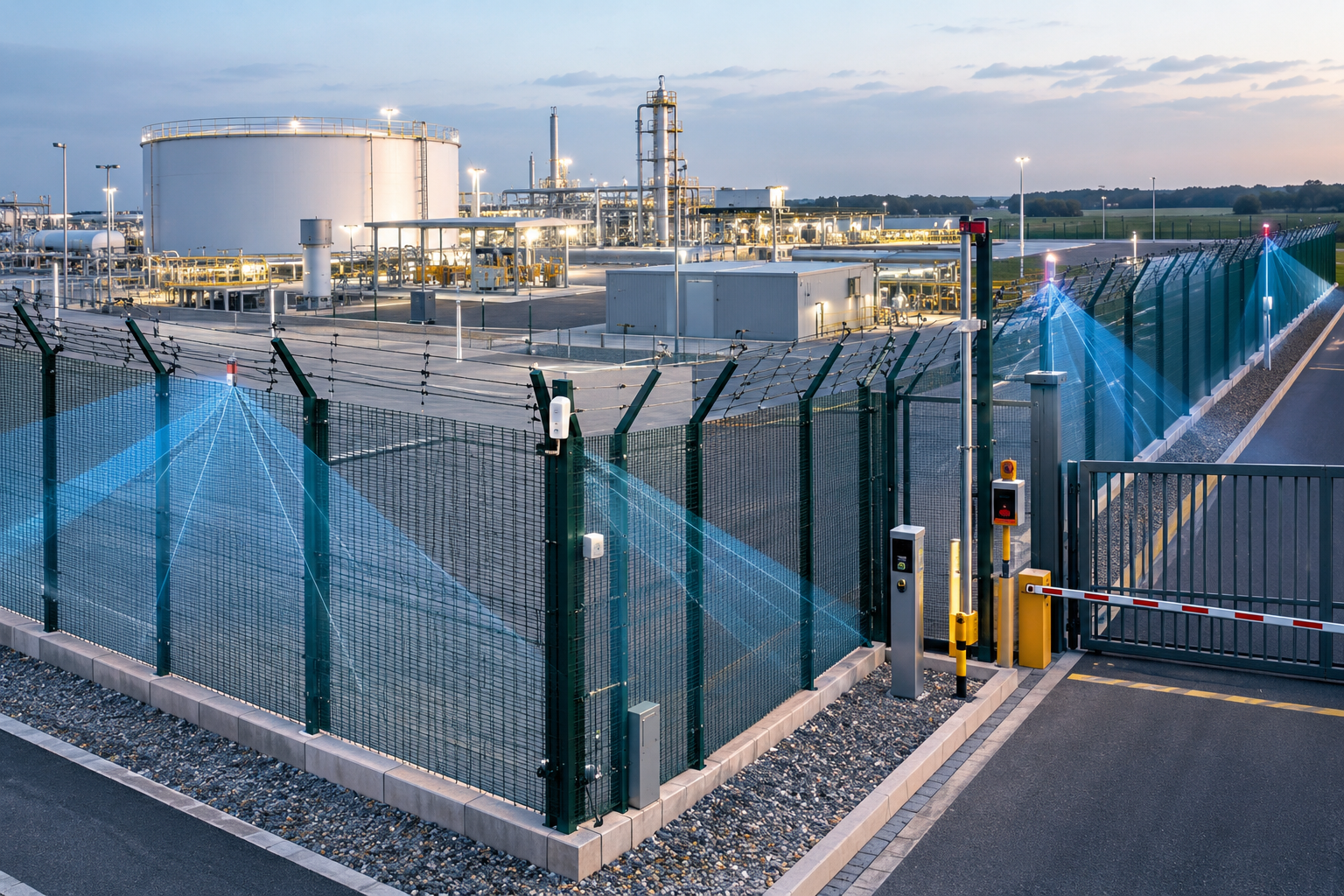
A fence creates a physical boundary that an intruder must overcome. A PIDS can identify an intrusion attempt at the perimeter, depending on the technology and installation, allowing the appropriate security team to investigate and respond.
Sysco Technical Solutions designs, supplies and installs perimeter intrusion detection systems tailored to the site, risk profile and perimeter configuration. Its fence intrusion detection solutions can detect and locate attempts to climb, cut or breach a protected fence.
Sysco’s current perimeter protection product range includes technologies such as EcoPoint, SinglePoint 3D, NeoLine and FlexLine, with solutions selected according to the requirements of the protected site and perimeter.
This creates an important distinction:
Physical protection
The fence creates a barrier that makes unauthorised entry more difficult and can provide valuable delay.
Detection
A PIDS can identify activity at the perimeter and generate an alarm, depending on the technology and configuration.
Response
The detection system needs to form part of an appropriate security response process.
A strong perimeter security strategy therefore considers physical protection, detection and response together.
How Gates Affect Perimeter Fence Security
A perimeter is only as strong as its access arrangements.
Vehicle gates, pedestrian gates and emergency access points need to be treated as part of the security boundary rather than as separate infrastructure.
Important considerations include:
- Gate construction
- Access-control arrangements
- Locking mechanisms
- Gaps around gates
- Emergency access and egress
- Vehicle access management
- Integration with perimeter intrusion detection
- Detection around vulnerable access points
A high perimeter fence with an inadequately protected gate can undermine the intended security level.
For this reason, gates should be considered during the initial perimeter security design rather than added as an afterthought.
What Other Factors Determine the Correct Fence Height?
When specifying perimeter fencing, security managers should consider:
1. Site risk
What credible threats is the site expected to face?
2. Threat level
What level of capability could a potential intruder have?
3. Asset value
What would be lost, damaged or disrupted following an intrusion?
4. Consequences of intrusion
Could an incident affect safety, operations, business continuity or critical infrastructure?
5. Required delay
How much time is needed between an intrusion attempt and an effective security response?
6. Fence location
Is the boundary exposed, isolated, overlooked or adjacent to publicly accessible areas?
7. Terrain
Changes in ground level and site conditions can affect the effective height and security of the boundary.
8. Adjacent structures
Buildings, equipment and other structures can affect the effectiveness of the perimeter.
9. Gate arrangements
Vehicle and pedestrian access points must be considered as part of the complete perimeter.
10. Intrusion detection
Determine whether a PIDS is required and which technology is appropriate for the fence and environment.
11. Security response
Detection is most effective when there is a defined process for investigating and responding to alarms.
12. Applicable standards and guidance
The final specification should be checked against relevant current standards, NPSA guidance and project-specific requirements.
Should You Replace an Existing Fence or Upgrade It?
Replacing an entire perimeter is not necessarily the first or only option.
A site assessment may identify opportunities to improve an existing perimeter through measures such as:
- Increasing fence height
- Improving anti-climb characteristics
- Addressing vulnerable gaps
- Upgrading gates
- Adding perimeter intrusion detection
- Improving alarm arrangements
- Strengthening vulnerable sections of the boundary
However, not every existing fence will be suitable for every upgrade.
The fence type, structural condition, installation arrangement and requirements of the proposed detection technology all need to be assessed.
Sysco Technical Solutions’ fence intrusion detection systems are designed for use with a range of fence types, including mesh, chain-link, palisade and solid-panel fences.
The sensible starting point is therefore a professional perimeter security assessment, rather than assuming that complete fence replacement is required.
How to Choose the Right Perimeter Security Fence
A practical process is:
Step 1 – Assess the threat
Understand the credible threats and likely methods of intrusion.
Step 2 – Identify what must be protected
Consider the assets, operations and consequences of a successful intrusion.
Step 3 – Determine required delay and detection
Establish how the physical barrier and detection system need to work together.
Step 4 – Select the appropriate fence design
Specify height, construction and anti-climb characteristics according to the identified requirement.
Step 5 – Secure gates and access points
Ensure vehicle, pedestrian and emergency access points form part of the overall perimeter security design.
Step 6 – Consider perimeter intrusion detection
Determine whether a PIDS solution is appropriate and which technology best suits the fence, site and threat profile.
Step 7 – Consider the security response
Define what happens after an alarm is generated and who is responsible for responding.
Step 8 – Check applicable standards and guidance
Confirm the final design against relevant current standards, NPSA guidance and project-specific requirements.
This risk-led approach avoids the common mistake of choosing a fence first and trying to build a security strategy around it afterwards.
Does Your Site Need a High-Security Perimeter Fence?
A perimeter security review may be worthwhile if your organisation has:
- High-value or critical assets
- A history of intrusion attempts
- Vulnerable or ageing boundary fencing
- Poorly secured gates
- Blind spots or vulnerable sections around the perimeter
- No perimeter intrusion detection
- A significant change in the site’s risk profile
- New security requirements
- A major site expansion or redevelopment
For critical infrastructure security, the question is not simply whether the existing fence looks substantial.
The more important question is whether the perimeter provides the required level of deterrence, delay and detection, supported by an appropriate response.
Conclusion – How High Should a Perimeter Security Fence Be?
There is no single correct height for every perimeter.
For security-fence applications, NPSA guidance provides minimum panel heights of 2.4m for its defined security-fence application and 3.0m for higher security requirements, alongside additional security measures.
However, these figures should not be treated as a universal legal requirement or as a substitute for a site-specific security assessment.
The right perimeter security fence depends on the site’s security risk, the assets being protected, the threat environment, the required delay and the wider perimeter protection strategy.
For a high-security perimeter, the strongest approach is rarely simply “make the fence taller.”
Instead, organisations should consider the complete perimeter: appropriate security fencing, secure gates, anti-climb characteristics, perimeter intrusion detection and a clearly defined response process.
Sysco Technical Solutions
Sysco Technical Solutions specialises in perimeter security and perimeter intrusion detection solutions for high-risk and critical infrastructure environments.
The company designs, supplies and installs tailored PIDS solutions, including fence intrusion detection systems and a range of perimeter protection products. Its current product range includes EcoPoint, SinglePoint 3D, NeoLine and FlexLine technologies.
If you are reviewing the security of an existing perimeter or planning a new high-security site, Sysco Technical Solutions can help assess the wider perimeter protection requirements, including fencing and perimeter intrusion detection.
5 FAQs
How high should a security fence be?
There is no universal height. NPSA guidance recommends minimum 2.4m panels for its security-fence application and 3.0m for higher security requirements, alongside additional security measures.
Is a 2-metre security fence high enough?
It may be suitable for some sites, but height alone does not determine security. Threat level, fence design, anti-climb characteristics, gates, detection and response arrangements must also be assessed.
Does a taller security fence provide better protection?
Greater height can increase physical deterrence and delay, but a taller fence can still have vulnerabilities if gates, ground-level gaps or detection arrangements are poorly designed.
What is PIDS in perimeter security?
PIDS stands for Perimeter Intrusion Detection System. It describes sensor-based technologies designed to detect unauthorised activity or attempted intrusion at a site’s perimeter.
Should a security fence be combined with PIDS?
For higher-risk environments, combining an appropriately specified physical barrier with perimeter intrusion detection can create a stronger layered perimeter protection strategy. The appropriate PIDS technology depends on the site, fence type and risk profile.