
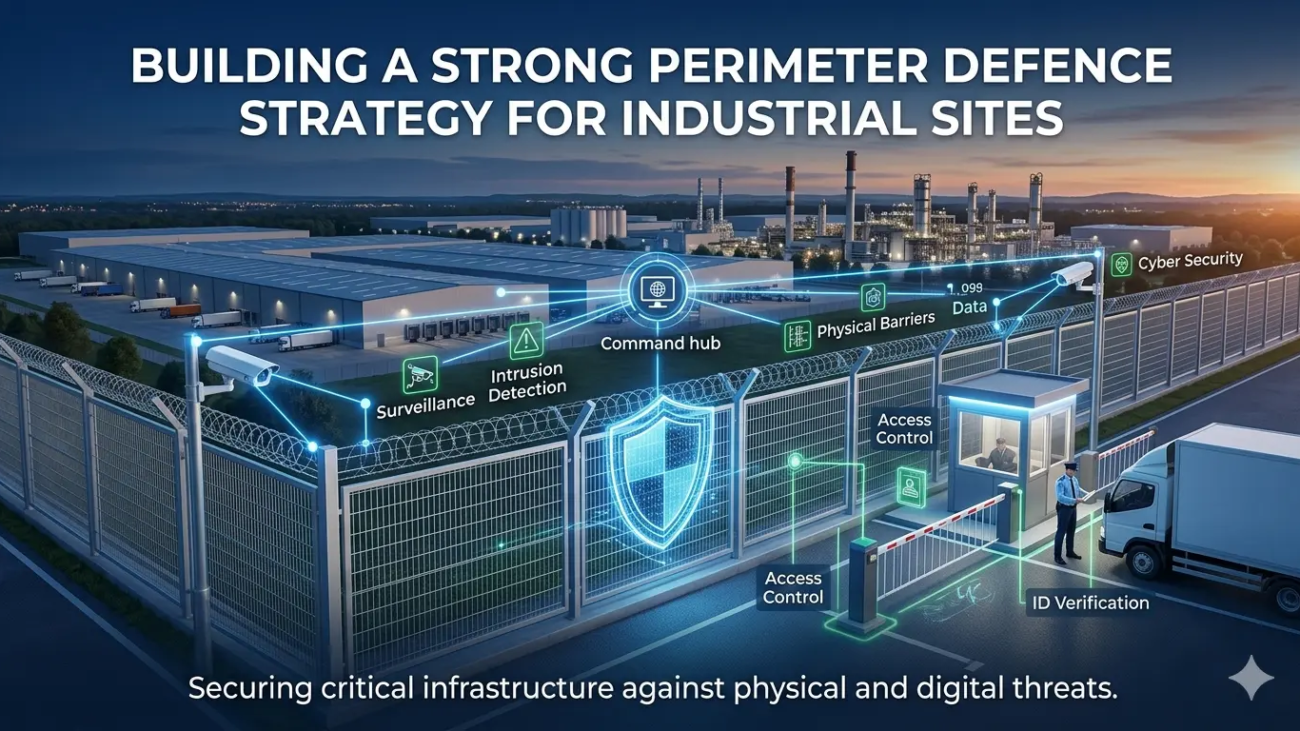
Industrial facilities require strong security to protect assets, equipment, and other valuable resources. Companies install advanced perimeter systems to prevent unauthorised access. An effective defence plan minimises risk and maintains normal operations.
Perimeter solutions that are modern are a combination of technology, monitoring and physical structures used in securing industrial environments. It is a good perimeter approach that encompasses prevention, detection, and response. This method allows organisations to secure big areas and infrastructure that is important to them with ease.
Why Industrial Sites Need Advanced Perimeter Protection Systems
Industrial sites are most of the time big and contain valuable equipment and thus are prone to theft, vandalism and intrusion. The old security provisions are often ineffective when faced by determined intruders. Current perimeter systems also provide 24/7 monitoring and rapid detection of threats.
The systems also allow the security teams to take direct action. They reduced the time of loss, downtime and safety risks. Higher security is also applied in protecting workers and businesses. Companies also remain productive and work in a safe environment.
Key Components of Effective Perimeter Security Systems
Good defense should be built using integrated technologies. The components enhance each other to form a well-based protection layer.
Physical Barriers
The first level of defense is physical restraint, i.e. fencing, gates, and fortified walls, which restrict access points. Fencing of high quality prevents intruders even before they attempt intrusion. Access gates under control can be accessed only by authorised workers on the site. Therefore, physical infrastructure is vital in contemporary perimeter security.
Intrusion Detection Technology
Intrusion detection systems monitor the boundary walls twenty-four hours a day. They indicate suspicious activities or violations immediately. Typical ones are motion sensors, vibration sensors and infrared detectors. Fibre optic fence surveillance provides very precise alerts. Teams in charge of security are notified that something strange is taking place.
Video Surveillance Systems
Video surveillance provides an aspect of real-time monitoring to the perimeter scheme. Cameras are used to capture the activities during entry points and sensitive areas. There are thermal cameras and AI analytics as part of modern systems, able to detect movement even at low light or adverse conditions. Integrated cameras allow teams to check the alarms fast, eliminating false alarms and allowing rapid response times.
Access Control Integration
Effective entry is controlled by access control systems. They monitor the employees, visitors and contractors that access the facility. The identification is enhanced by card readers, diverse biometric scanners, and digital credentials. Enhanced logs are automated entries. This will enable full visibility of site access and movement to organisations.
Designing a Comprehensive Perimeter Security Strategy
Industrial security requires planning and risk analysis. Businesses have to identify weak points prior to making a selection of technologies. Begin with an evaluation of site security. It determines weak points, access points and probable threats.
The second step is to choose layered perimeter defenses. Layering provides support for one system to the other. In one case, fencing is used with sensors and cameras, whereby the intruders get various barriers placed in their path. It can be faster to put all of it into a centralised body of monitoring. Alert visuals are displayed simultaneously in teams.
Benefits of Modern Perimeter Security Solutions
Modern Perimeter Security Solutions technology offers several advantages for industrial facilities.
Early Threat Detection
Sensors alarm the suspicious activity before the intruders get to the restricted zones. Teams are able to react to the incidents before things get out of control.
Improved Operational Safety
There are a lot of sites where dangerous devices or materials are stored. The existence of strong perimeter barriers prevents illegal entry into the dangerous zones. The result is much higher levels of safety for the employees.
Reduced Theft and Vandalism
Criminal acts are thwarted by security systems. Potential intruders are stopped by visible cameras, sensors and barriers. Companies experience fewer losses and reduced damage to equipment.
Enhanced Monitoring and Control
Security teams monitor perimeter solutions through centralised monitoring systems. Most of the systems run on one platform through Teams. Remote access enables the managers to observe the locations from anywhere.
Choosing the Right Perimeter Security Systems
The choice of the appropriate solution requires skills and attention. The techniques vary in size, design and the level of risk. Select scalable perimeter solutions that are suitable for the industrial environment.
Integrate dependable systems with sophisticated detection and high-quality surveillance. Monitoring platform integration enhances general management. Professional installation will ensure optimum performance. Appropriate installation will lower the rates of false alarms and increase the detection rates.
Strengthening Industrial Security for the Future
Industrial security threats continue to evolve. Therefore, businesses must adopt advanced perimeter security systems to protect valuable infrastructure. A layered defence strategy offers the most reliable protection. Physical barriers, detection systems, and surveillance work together effectively.
Additionally, integrated perimeter security solutions improve monitoring, response, and control. As a result, industrial facilities maintain safety, productivity, and operational stability. Organisations that invest in modern perimeter protection systems create safer environments and reduce security risks. Consequently, businesses secure their assets and ensure long-term operational success.

