
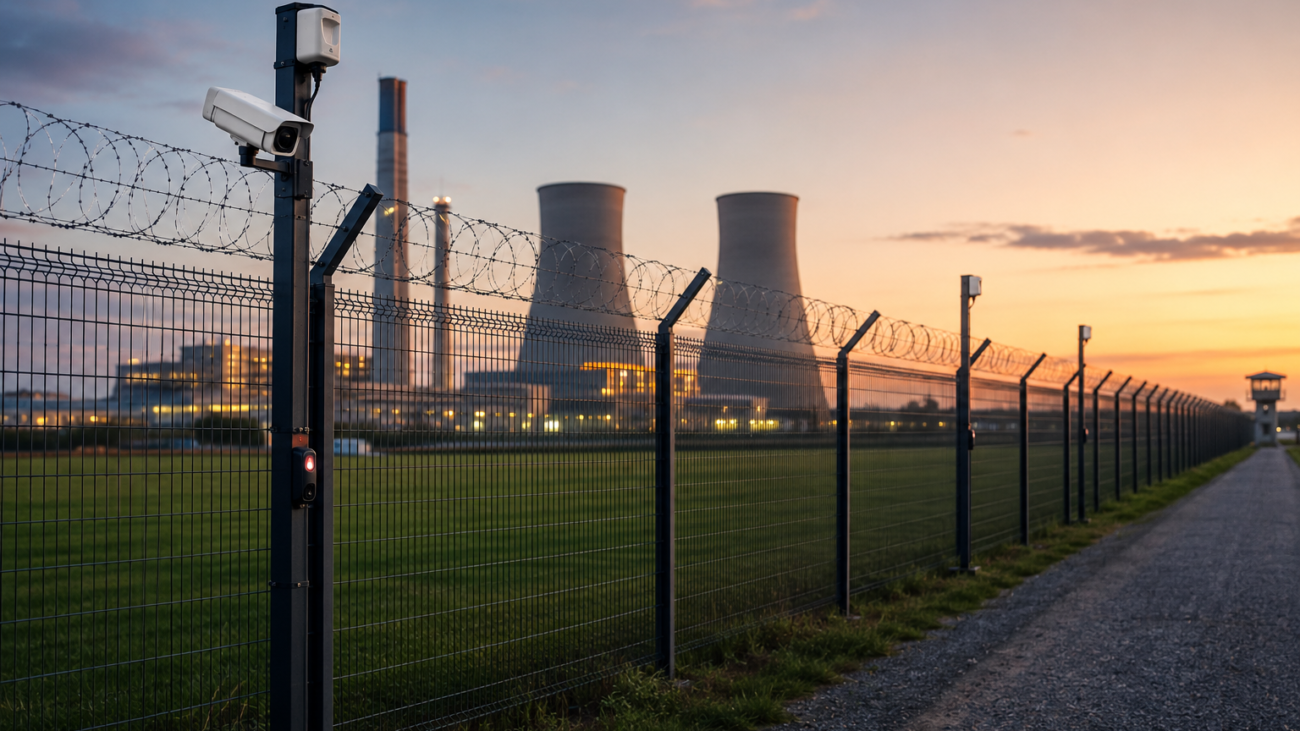
Modern perimeter security is no longer a physical barrier problem – it is a multi-layer detection and response architecture designed to protect high-risk environments where intrusion is not just a security issue, but an operational and financial threat.
Today’s perimeter security systems combine sensor fusion, AI-based detection, and integrated command platforms to deliver real-time situational awareness across critical infrastructure such as aircraft hangars, vehicle storage depots, component manufacturing plants, and energy facilities.
These environments require more than fencing. They require perimeter intrusion detection systems (PIDS) capable of detecting, classifying, and escalating threats before a breach occurs.
Modern Perimeter Security Systems: From Passive Fencing to Active Detection Networks
Traditional fencing acted only as a physical delay barrier. Modern systems transform the perimeter into a live detection zone.
A fully deployed perimeter protection system typically includes:
- Fence-mounted vibration or tension sensors
- Fibre optic intrusion detection cables
- Microwave and radar detection fields
- Thermal and CCTV verification layers
- Centralised command & control integration
Instead of reacting after a breach, modern systems create an early warning envelope, detecting activity at the boundary line itself.
This is the core evolution of modern physical security systems – shifting from reaction to prediction and prevention.
Perimeter Intrusion Detection Systems (PIDS): How They Actually Work
A perimeter intrusion detection system (PIDS) is designed to identify abnormal activity along a protected boundary and trigger verified alerts in real time.
Unlike simple alarm systems, PIDS solutions use multiple detection methods:
- Mechanical vibration analysis (fence disturbance)
- Electromagnetic field disruption
- Seismic ground sensing
- Radar movement tracking
- Video analytics confirmation
When combined, these technologies create a layered detection grid that reduces false alarms while increasing detection confidence.
Fence-based systems, often called fence intrusion detection systems, remain one of the most widely used formats due to their precision and cost efficiency.
In high-security environments, PIDS is always integrated into broader perimeter detection systems and SOC (Security Operations Centre) workflows.
Aircraft & Aviation Security: Zero-Tolerance Perimeter Protection
Airports, aircraft storage zones, and maintenance hangars operate under extreme security constraints where even a minor breach can escalate into national-level risk.
In these environments, perimeter security systems are deployed as multi-zone detection architectures:
- Outer perimeter radar detection zones
- Fence-mounted intrusion detection layers
- Thermal imaging for low-visibility coverage
- AI-driven CCTV verification systems
The goal is not just detection, but instant classification of threats – distinguishing between humans, wildlife, and environmental movement.
Advanced aviation-grade perimeter protection systems are also directly integrated into control towers and central monitoring systems, ensuring immediate operational response.
Vehicle Storage & Logistics Depots: High-Value Asset Protection
Vehicle compounds and logistics hubs represent high-theft, large-area environments where traditional security fails due to scale.
Modern fence protection systems and perimeter detection systems are used to solve three core problems:
- Wide boundary coverage
- Night-time intrusion detection
- Rapid alert validation
AI-enhanced fence intrusion detection systems play a major role here by filtering environmental noise such as wind vibration or vehicle movement outside the perimeter.
These systems are often combined with CCTV analytics and lighting automation, forming a responsive physical security system that actively deters intrusion attempts.
Manufacturing & Industrial Sites: Protecting Operations and IP
Component manufacturing facilities require protection not only of physical assets but also intellectual property and production continuity.
Here, industrial perimeter security systems are deployed as integrated ecosystems:
- Smart fencing with embedded sensors
- Access-controlled entry points
- Internal motion detection zones
- Centralised monitoring platforms
A strong perimeter protection system ensures that any breach attempt is detected before internal zones are compromised.
Unlike basic security setups, these systems operate as part of a layered fencing and security architecture, where each layer escalates detection sensitivity.
Power Plants & Critical Infrastructure: High-Resilience Security Design
Power stations and utility infrastructure require the highest level of protection due to national dependency and operational risk.
These environments deploy redundant perimeter intrusion detection systems, often combining:
- Fibre optic sensing lines
- Microwave barriers
- Radar detection grids
- Buried seismic sensors
This redundancy ensures continuous protection even under harsh environmental conditions.
In critical infrastructure, perimeter protection systems are not optional – they are part of operational resilience strategy.
The Role of Perimeter Protection Products in Modern Security Design
Modern perimeter protection products are modular and scalable, allowing systems to be designed based on threat level and site complexity.
These include:
- Intelligent sensor nodes
- AI analytics platforms
- Integrated alarm systems
- Command centre software
- Hybrid detection technologies
The shift is toward smart perimeter ecosystems, where every device contributes to a unified security intelligence network.
Why Modern Systems Outperform Traditional Security Fencing
Traditional fencing only delays intruders. Modern systems detect, analyse, and respond in real time.
Key advantages of modern perimeter security systems:
- Early-stage intrusion detection
- Reduced false alarms via AI filtering
- Real-time CCTV verification
- Integration with security operations centres
- Scalable deployment across large sites
This makes modern systems essential for any high-risk industrial or infrastructure environment.
FAQ
What is a perimeter security system?
A system designed to detect and prevent unauthorised access using sensors, detection technologies, and monitoring platforms.
What is a perimeter intrusion detection system (PIDS)?
A detection system that identifies intrusion attempts along boundaries using sensor-based technologies.
Where are perimeter security systems used?
They are used in aviation, energy, manufacturing, logistics, and critical infrastructure sectors.
What is fence intrusion detection?
A sensor-based system that detects tampering, climbing, or cutting of fencing structures.
Are modern systems better than traditional fencing?
Yes – they actively detect and respond to threats instead of only acting as physical barriers.

