
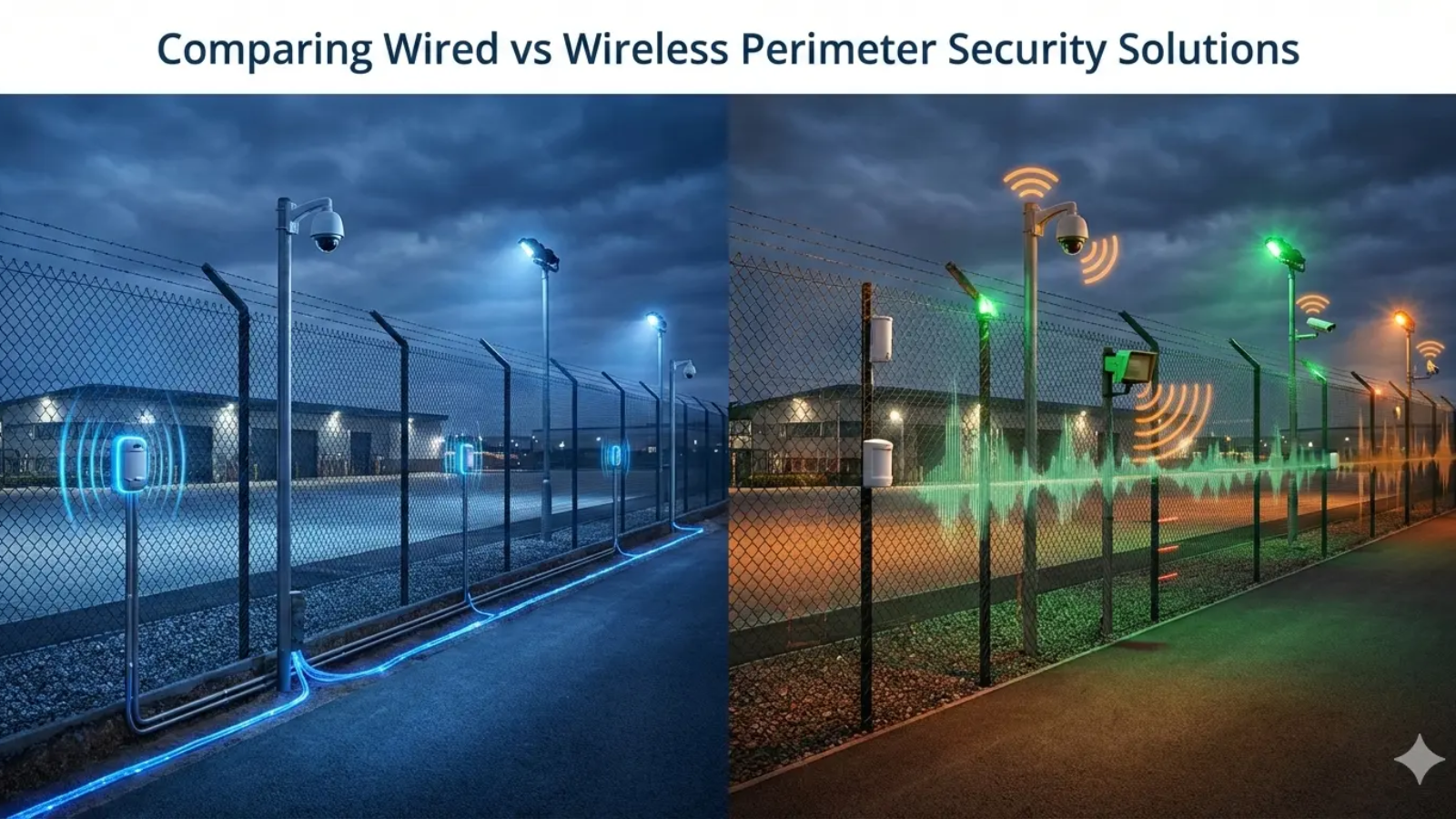
Perimeter security systems are essential for the protection of commercial, industrial or infrastructure sectors. They are also the first line of defence, potential threats are observed and averted before intruders reach buildings, assets or people. In the UK, which is a security-compliant market that values reliability and return on investment, organisations must make a fundamental choice of wired versus wireless for perimeter security options.
Differences Both technologies have advantages, as well as limitations. Knowing how they stack up can allow you to choose a system that reflects your site environment, risk scenario and application requirements.
Understanding Perimeter Security Systems
Perimeter security products are constructed to manage borders like fences, walls, gates and open areas. They range from things such as intruder alarm sensors to CCTV, access control and alarms. It’s a simple game – you want to find unauthorised access quickly and give the right people the means to shoot out lights pronto.
Today’s perimeter security systems need to provide accuracy, low false alarms and easy integration with the overall security network. In the case of a wireless or wired security system, the result will depend on how compatible it is with the environment that it is babysitting.
What Are Wired Perimeter Security Solutions?
Wired Perimeter Detection Wired perimeter security options depend on physical cables to connect the sensors, controllers and monitoring systems. These cables are used to power data, ensuring a solid and consistent point around the perimeter.
Wired detection technologies commonly used on perimeters include fence-mounted vibration sensors, buried cable systems, infrared beams and hardwired CCTV. They are deployed in airports, datacentres, utilities and industrial facilities all over the UK.
Key Advantages of Wired Systems
-
High reliability due to stable physical connections
-
Consistent performance in all weather conditions
-
Lower risk of signal interference or hacking
-
Ideal for permanent or high-risk sites
Because wired systems don’t use radio transmission, they are immune to interference that will typically affect wireless systems. This makes them ideal for applications where security is paramount.
Limitations of Wired Perimeter Security
However, wired systems have their limitations. Installation can be followed by extensive trenching, groundwork, or changes in existing infrastructure. This may lead to higher initial savings and longer project timelines.
Perimeter security solutions that are physically wired are also less adaptable. For changing the cable route for site layout or short-term coverage, the expenditure incurred to relocate cables and equipment is expensive. This can be a limiting factor for organisations that anticipate growth or frequent reconfiguration.
What Are Wireless Perimeter Security Solutions?
Wireless Fence Options Wireless perimeter systems communicate to the sensors and devices through RF or Cell technology. Instead of wires, these systems use encrypted wireless signals to send alerts and information.
There is an increasing demand for wireless solutions, especially in the UK – whether it’s at a temporary site, remote location or in situations where cabling would be too problematic. They can, however, often be seen in building sites, depots, car parks and in historic areas.
Key Advantages of Wireless Systems
- Faster and less disruptive installation
- Lower initial infrastructure costs
- High flexibility and scalability
- Perfect for temporary or changing locations
Wireless makes it possible for businesses to rapidly install perimeter security with very little initial infrastructure. This makes them appealing to organisations requiring gradual protection or for use over the short term.
Limitations of Wireless Perimeter Security
While wireless perimeter security solutions offer flexibility, they are not without drawbacks. Performance can be impaired if construction, vegetation or other wireless signals prove troublesome.
Battery-operated sensors also need maintenance to continue proper operation. While contemporary systems are secure, wireless networks can become vulnerable to cyber threats if not encrypted or managed appropriately.
These considerations need to be weighed carefully for high-risk/critical premises before making a wireless decision.
Wired vs Wireless: A Direct Comparison
When it comes to choosing between a wired or wireless perimeter security system, the choice depends largely on location-specific needs.
Reliability:
Wired-based solutions are typically more reliable and stable in nature, catering to critical infrastructure. l Wireless systems do a great job if designed professionally, but may encounter environmental difficulties as well.
Installation:
Wireless systems win on speed and ease of installation, while wired products take more planning and groundwork.
Scalability:
Wireless solutions are easier to scale or move. Wired options are permanent and durable.
Cost:
Wired systems tend to cost more up front, but provide continued savings for life. Wireless may be inexpensive initially, but you need to think about battery life and monitoring.
Selecting the Right Perimeter Security Solution
There is no one-size-fits-all answer. Indeed, many recently constructed UK sites have embraced hybrid perimeter security solutions where there is a blend of wired and wireless. For instance, a wired fence detection may coexist with wireless sensors in the field for use in remote or temporary locations.
In choosing a perimeter protection system, you should think about:
- Site size and layout
- Level of security risk
- Environmental conditions
- Budget and long-term plans
- Integration with existing security systems
Professional system planning and risk assessment are a prerequisite for the optimum protection of property and personnel.
The Future of Perimeter Security in the UK
Along with technology advancements, wired and wireless perimeter security solutions are getting better. On both platforms, accuracy is being bolstered and false alarms are decreasing by the use of analytics, AI-based detection applications and intelligent monitoring.
When it comes to security, the perfect system will offer the right level of protection and responsiveness. Regardless of whether it is wired, wireless or a combination of both, properly designed systems give peace of mind and real protection when and where it counts.
This ensures that decision-makers can be confident in their selection of perimeter security solutions, which offer lasting value and long-term security.


Add a Comment